
Weekly Algorithm: Executable vs Payoff Arbitrage: Why Polymarket’s NegRisk Adapter Creates One-Sided Edges

By Tiger Polymarket Prediction
August 9, 2026
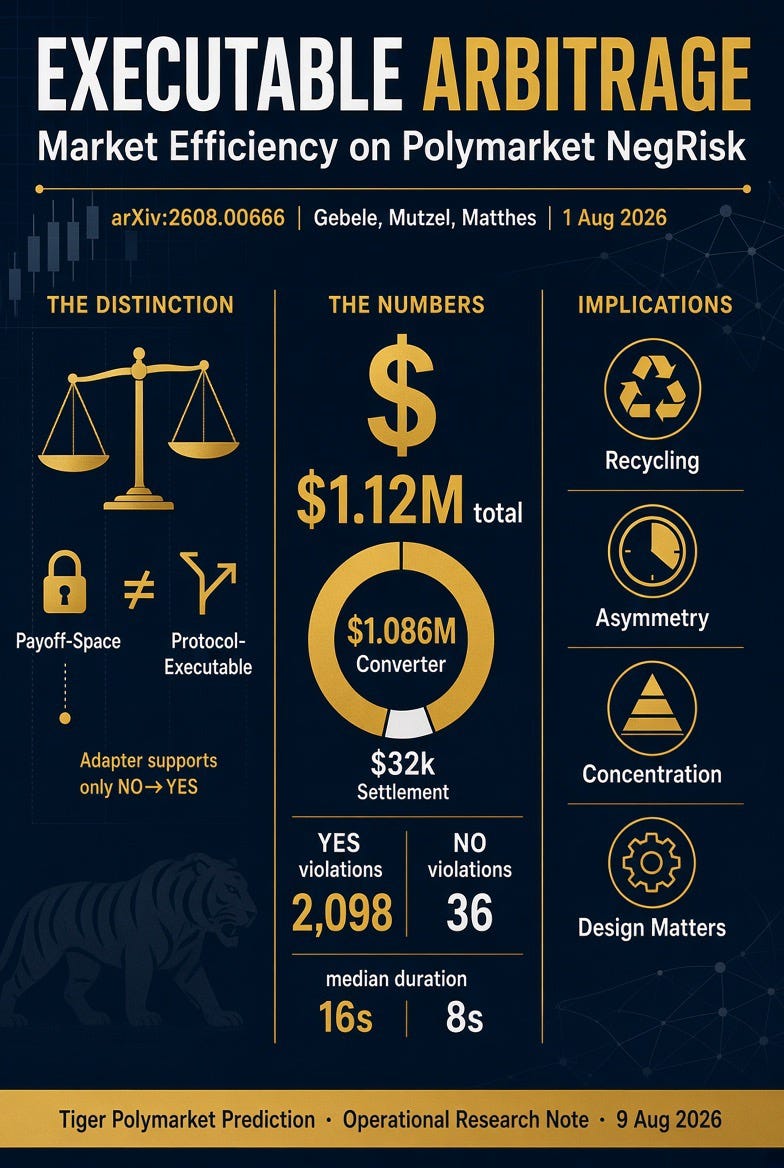
This week’s most precise microstructure paper is “Executable Arbitrage and Market Efficiency in Prediction Markets” (arXiv:2608.00666, 1 August 2026) by Jonas Gebele, Timm Mutzel, and Florian Matthes.
It draws a clean distinction that every production system on Polymarket must internalize: payoff-space no-arbitrage (what the terminal payoffs mathematically require) is not the same as protocol-executable no-arbitrage (what traders can actually realize before settlement with the tools the protocol provides).
The Core Distinction on NegRisk Markets
Polymarket’s negative-risk (NegRisk) markets link binary contracts that represent mutually exclusive outcomes. In theory, the sum of prices across a complete set should not deviate from $1 after fees. In practice, the NegRisk Adapter only operationalizes the NO → YES conversion path before settlement. The reverse path is not executable until resolution.
The authors reconstruct depth-aware executable portfolio values from CLOB data, combine them with actor-level transaction histories and on-chain conversion traces, and measure both violations and actual exploitation.
Quantitative Results
Total reconstructed arbitrage profit: $1.12 million.
• Converter-enabled strategies (using the Adapter): $1.086 million (≈97 %)
• Settlement-based basket formation: $32 thousand
In the CLOB sample:
• Positive YES-side violations: 2,098 episodes (median duration 16.15 s)
• Positive NO-side violations: 36 episodes (median duration 7.99 s)
YES-side violations are both far more frequent and longer-lived. NO-side violations are rare and short because the Adapter lets traders convert and recycle collateral immediately. Top-10 addresses captured roughly 75 % of converter profit.
A prototype bidirectional Adapter extension (YES → NO) is shown to be technically feasible at modest additional gas cost, but requires a finalized active-outcome set.
Practical Implications for Live Systems
1. Theoretical parity is not tradable parity. An apparent violation on the unsupported YES side may require capital lock-up until settlement. Systems that treat every payoff-space edge as immediately executable will overstate realizable profit and understate capital-at-risk.
2. Directionality matters. Edges that can be closed via the existing NegRisk Adapter are enforced faster and generate the large majority of realized profit. Edges that cannot are slower and smaller in aggregate.
3. Inventory recycling is a first-order feature. Pre-settlement conversion reduces capital lock-up and enables rapid inventory turnover. Strategies that ignore this mechanism miss the dominant profit channel documented in the paper.
4. Concentration is high. A small number of addresses extract most of the converter-enabled profit. Monitoring conversion activity and residual YES inventory of these addresses is more informative than generic order-flow signals.
5. Protocol design shapes microstructure. Market efficiency is not solely a function of payoff identities; it also depends on whether the protocol exposes the corresponding transformations as atomic, pre-settlement primitives. One-sided adapters create measurable asymmetries in violation incidence, duration, and profitability.
How We Are Adapting
We have updated the NegRisk monitoring layer to separately flag and size:
• Adapter-supported (NO-side) opportunities — higher priority, tighter capital allocation, faster expected mean-reversion
• Unsupported (YES-side) opportunities — lower priority, explicit capital-lock-up haircut, settlement-risk adjustment
Conversion traces are now part of the live counterparty and inventory-risk feed. Any residual YES position that cannot be recycled pre-settlement is treated as a longer-duration exposure.
This paper is valuable because it replaces the simple “sum-to-one” heuristic with a protocol-aware view of what is actually executable. For systematic strategies on Polymarket’s multi-outcome markets, that distinction is operationally decisive.
I will share the exact classification rules and capital-haircut schedule we are applying in the next note.
Engineering questions from teams running NegRisk inventory are welcome.
Tiger Polymarket Prediction
P.S. Not financial advice. Prediction markets involve substantial risk of loss. All numbers and findings above are taken directly from the paper’s reconstruction of CLOB states, conversion traces, and actor-level profits. Trade only what you can afford to lose.